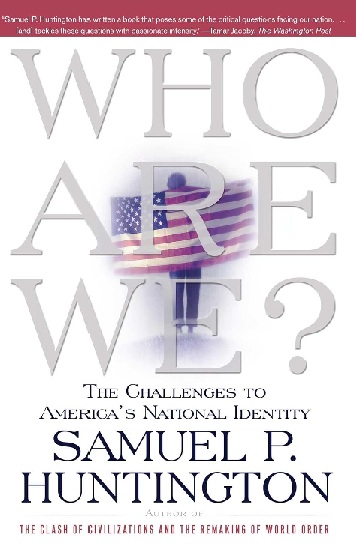
I recently was directed to a commentary in a book by Samuel P. Huntington, a lifelong Democrat and one of the most influential American political scientists of the late 20th century.
Huntington, a Yale graduate who earned his Ph.D. from Harvard at age 23, went on to spend 58 years at Harvard University, where he served as Chair of the Government Department, Director of the Center for International Affairs, and founder and co-editor of the journal Foreign Policy. Beyond academia, he advised multiple U.S. administrations on security and foreign policy, including serving on the National Security Council under President Jimmy Carter. His combination of rigorous scholarship and real-world policy influence made him a rare bridge between the ivory tower and the corridors of power, with his work shaping debates on democracy, national identity, and international relations that remain relevant today.
In his book Who Are We?, copyrighted in 2004, he wrote about the period in America between the '60s and the turn of the century. While written more than twenty years ago, it seems to have even more relevance today.
Many elite Americans were no longer confident of the virtue of their mainstream culture and instead preached a doctrine of diversity and the equal validity of all cultures in America. To the extent that America has become multicultural, immigrants may choose among the subcultures they encounter or choose to maintain their original culture.
They may assimilate into American society without assimilating the core American culture. Assimilation and Americanization are no longer identical... The differences between a "patriotic public" and "denationalized elites" parallel other differences in values and philosophy.
Growing differences between the leaders of major institutions and the public on domestic and foreign policy issues affecting national identity form a major cultural fault line cutting across class, denominational, racial, regional, and ethnic distinctions. In a variety of ways, the American establishment, governmental and private, has become increasingly divorced from the American people.
Politically America remains a democracy because key public officials are selected through free and fair elections.
In many respects, however, it has become an unrepresentative democracy because on crucial issues, especially involving national identity, its leaders pass laws and implement policies contrary to the views of the American people.
Concomitantly, the American people have become increasingly alienated from politics and government.
As I mentioned above, this was written more than 20 years ago by a lifelong Democrat, and if he could see it then, I have a hard time believing that the Democratic Party has any interest in being in touch with the American public. They are the "denationalized elites" Huntington was referring to.
"Prove Me Wrong"
If you are interested, you can get his book Here on Amazon.